
Call us 0800 78 345 87
English Dial Clock Maintenance
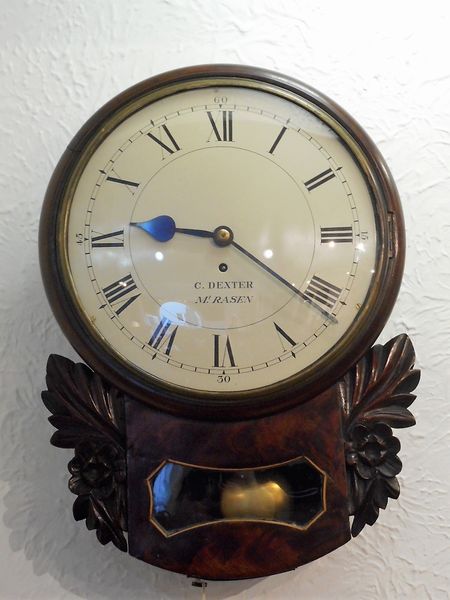
These fine clocks are mainly simple time pieces but sometimes are striking hours. Pendulums should always be removed or secured for moving the clock to prevent damage. Ensure your key is a snug fit and push right on to avoid damage to the dial.
Setting Up English Dial Clocks
The pendulums of English Dial Clocks take two forms, either detachable or not, depending on what type of escapement is used. Anchor and dead-beat escapements have detachable pendulums. Verge escapements found on very early clocks do not normally have detachable pendulums.
To remove the detachable pendulum there are a few steps. Lift up the pendulum and top suspension spring block and bring back clear of the back cock and crutch pin. To replace the pendulum reverse this procedure but ensure the brass suspension block pin sits into the notch of the top of the back clock and also that the crutch is inside the slot of the pendulum rod. For wall clocks put the pendulum on after the clock is hanging on the wall.
For attached pendulums it is simply moved to one side and hooked up into the side hook or unhooked to release. It is common that these hooks are missing in which case the pendulum should be padded inside the case to stop it moving. Do not attempt to remove the pendulum in any way.
After hanging or releasing the pendulum it is necessary to check the "tick". This must be even in order that the clock continues to function. Swing the pendulum gently and listen - if you are not sure whether it is even or not, try raising one side of the case and listen to see what that sounds like. On a wall clock move it out of vertical. If the "tick" is uneven the crutch arm has to be bent, unless it has an adjustable crutch which is sometimes used in late wall clocks.
First decide which way the crutch arm is to be bent by making the "tick" correct by lifting up one side of the case, or with a wall clock pivoting on the hanging screw. If the clock is raised up on the right (looking from the front) bend the crutch slightly to the left (looking from the back). The pendulum rod itself is bent in the case of fixed pendulums with verge escapement. If the clock is raised up on the left, bend the crutch to the side that is raised. Then try the reaction and decide if the bend was too much, not sufficient or now correct. With English wall clocks it may be necessary to unpeg the surround from the hanging box to enable sufficient access to the crutch the arm need not be bent as the same effect is achieved by rotating the knurled brass nut carrying the crutch pin one way or the other.
Wall clocks, after they are set in beat in the vertical position, often have securing plates which can be screwed through to stop the clock moving when winding. A double sided sticky pad behind the bottom of the case will help keep the clock in position.
Winding English Dial Clocks
Wind the clock once a week in a clockwise direction. (American clocks often wind the other way). If the clock is a striking clock wind both sides. One spring drives the strike and the other spring drives the hands. Wind until the key comes to a definite stop which after seven days will be 28 half turns on each square or more if the clock has run slightly longer. This applies only to fusee clocks which vast majority of English Dial clocks are. For quarter chiming clocks all three squares will require winding with the extreme right hand one driving the chime. Ensure your key fits the square properly, it must fit onto the square enough and have little if any slack. If the key is beginning to wear round then replace it as it may damage the clock squares. Striking clocks must be wound on both sides even if the clock is not wanted to strike, failure to wind the striking spring may stop the clock and can cause damage. Some bracket clocks are fitted with strike/silent devices which can be used.
Hand Setting
To set the hands to time always move the minute hand ONLY. On a timepiece clock (one which does not strike or chime) the minute hand can be moved forwards or backwards to reach the correct time. On striking clocks which sound the hours only, the minute hand can be moved forwards slowly to each hour allowing the clock to complete its striking each time before moving on.
City Clocks Maintenance
At City Clocks we will be happy to advise you on your English Dial Clock maintenance.
Contact City Clocks here or call us on 0800 78 345 87.

© City Clocks 2026 | Clock & Watch Restoration & Repairs | Tel: 0800 78 345 87
Legal & Privacy | Cookies | Sitemap | Website Development and Design by Fifteen.